
Roof Insurance Claims
A roof insurance claim is a process. We go through it with you — A to Z.
Storm damage is stressful, and the insurance side is where most homeowners feel lost. We've walked Houston families through it hundreds of times: the inspection, the filing, the adjuster meeting, and everything after. Here's how it actually works — honestly — and where having an expert in your corner makes the difference in how the process goes.
- GAF Certified · Factory-certified installer
- Insurance · Restoration specialists
- Family-Owned · Houston since 2023
The short answer
How does a roof insurance claim work in Texas?
You file with your insurer, they send an adjuster, and the adjuster writes an estimate. That first estimate often misses required line items, which is what a supplement corrects. We inspect first, document the damage in writing and photos, and meet the adjuster on the roof.
It starts on your roof — not on a form.
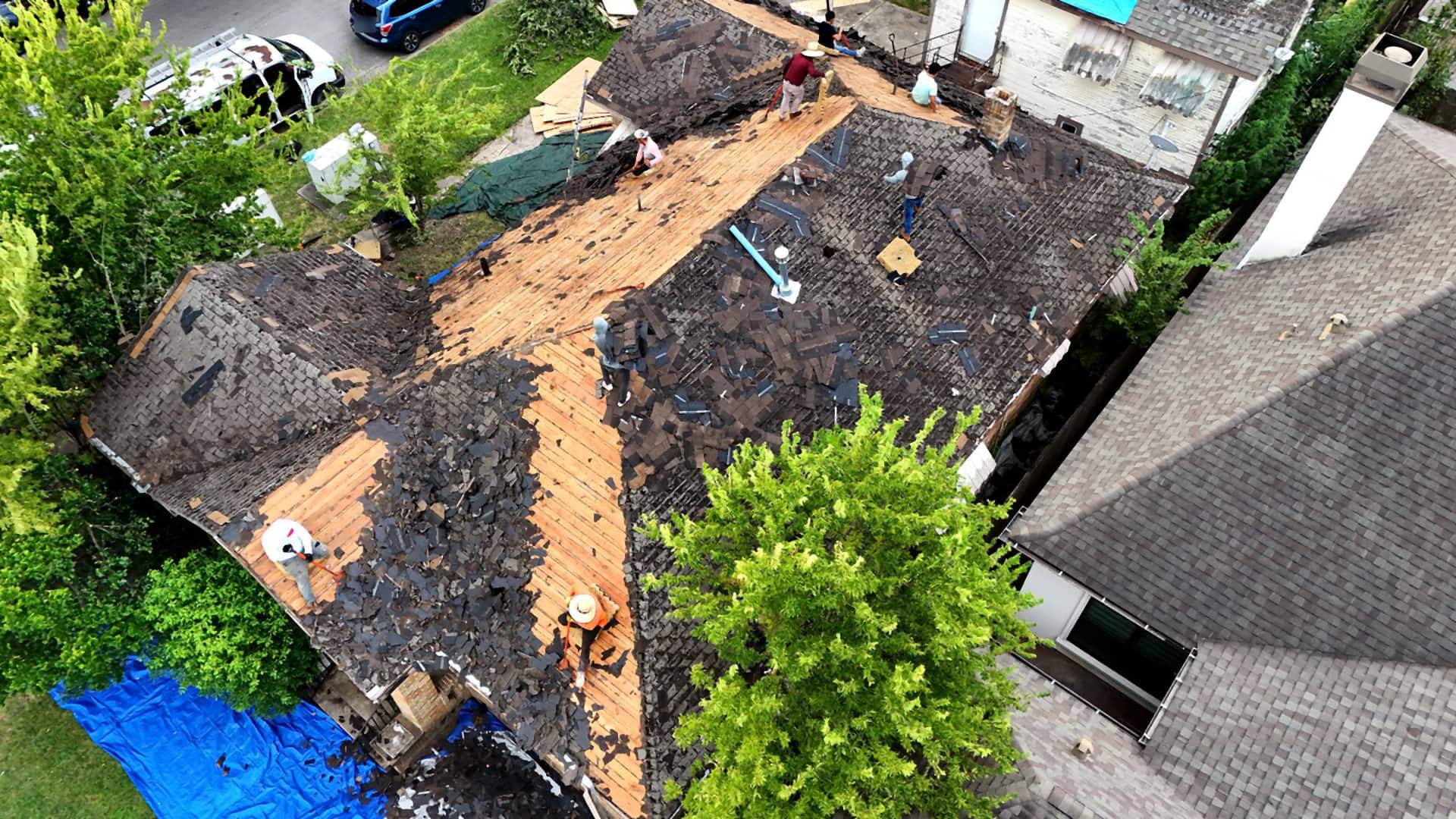
Every claim begins with a real inspection. We get up on your roof and do a thorough preliminary assessment: we gauge the roof's age, diagnose its overall condition, find any active leaks, and look closely for storm-related damage.
Then we tell you the truth about what we find. Sometimes a roof just needs some maintenance, not a replacement — and if that's the case, we'll say so. Other times a roof is near the end of its lifespan and there's legitimate storm damage worth pursuing with your insurance. Either way, you get a straight answer from someone who isn't trying to sell you a roof you don't need.
If you don't need a new roof, we'll tell you. Our reputation is worth more than one job.
Do you have a claim? →
The process, start to finish
What actually happens, step by step
Most homeowners have never filed a roof claim and don't know what's coming. Here's the whole path — and exactly where we step in.
- 01 The inspection & the honest recommendation
- 02 Filing the claim — together, in person
- 03 The adjuster meeting — we don't leave you (or the adjuster) alone up there
- 04 The first letter — where the race actually begins
- 05 Approval — still not the finish line
- 06 Supplementing what’s owed
- 07 The net claim, the deductible & recoverable depreciation
The inspection & the honest recommendation
We assess the roof, identify legitimate storm damage, and tell you whether filing a claim makes sense. No pressure either way.
Filing the claim — together, in person
When it makes sense to file, we recommend filing with our guidance — and it's our standard to be there with you when you do. Why in person? Because we want to make sure your claim gets a real, in-person adjuster inspection — someone who actually gets up on the roof. A drone flyover alone isn't enough to make a fair coverage decision, and we push for a proper look.
The adjuster meeting — we don't leave you (or the adjuster) alone up there
When the insurance adjuster comes out, we meet them on the roof and walk them through our findings. We don't leave the adjuster up there to evaluate it alone. We're there to make sure the damage is seen, documented, and fairly evaluated — so nothing legitimate gets missed or waved off.
The first letter — where the race actually begins
This is the step that trips up almost everyone. The first letter from the insurance company often looks like a denial, or comes back "under your deductible." Most homeowners read that and quit — and that’s the mistake. But if the insurer has acknowledged storm damage at all, that’s our green light — because now it’s about documenting the legitimate storm damage that’s there, so the full, fair scope of repair or replacement is on the record. Insurance is naturally conservative; the first number is rarely the real number.
Approval — still not the finish line
Even after approval, insurers tend to underpay. They'll leave line items out of the estimate — things genuinely required to do the job right. That's not your problem to catch. It's ours.
Supplementing what’s owed
After the work is done, we document and submit a supplement for the legitimate items the initial estimate left out — things like starter strip, valley metal, non-nailable decking, and painting of rooftop accessories. These are standard parts of a real roof replacement that insurers routinely omit, and we go back and claim them properly.
The net claim, the deductible & recoverable depreciation
Once approved, the insurer issues the net claim — the total replacement cost minus depreciation minus your deductible. When materials are delivered, we collect the deductible from you. On completion, we submit our certificate of completion and final supplemented estimate along with the deductible payment — and that’s what triggers the insurer to release the recoverable depreciation (the rest of what’s owed).
The words that confuse everyone: RCV, ACV, and depreciation.
Two little acronyms decide a lot about your claim, so here they are in plain English.
RCV — Replacement Cost Value
RCV policies pay what it actually costs to replace your roof today. They hold back "depreciation" at first, then release it (the recoverable depreciation) once the work is done and documented. With an RCV policy, your out-of-pocket is essentially just your deductible.
ACV — Actual Cash Value
ACV policies pay the depreciated value of your roof — replacement cost minus age and wear — and they don't give that depreciation back. With an ACV policy, filing a claim often isn't in your favor, because you'll have an additional out-of-pocket cost on top of your deductible. If you have an ACV policy, we'll tell you honestly — and we offer solutions to make an ACV policy easier to work with, so a replacement still makes sense for you.
We'll tell you which kind of policy you have and what it means for your wallet — before you commit to anything.
Two things almost everyone gets wrong.
"The first letter was a denial, so it's over."
It usually isn't. A first letter that looks like a denial or comes in under your deductible is often just the opening move. If storm damage has been acknowledged, the claim is very much alive — that's where the real work (and our job) begins.
"Filing a claim will raise my rates."
Here's the part insurers don't make obvious: filing a single claim isn't typically what drives your rate. What moves rates is the volume of claims in your area over a given period — after a major storm, an entire ZIP code sees rate movement whether you personally filed or not. So when your neighborhood has been hit, it's usually smartest to stay with the trend and take care of your home while the opportunity is there.
What your insurer won't remind you
Your RCV policy may quietly become ACV — and no one tells you.
Here's something most homeowners never hear until it's too late: it's very common for an insurer to switch your roof coverage from RCV to ACV — often around the 12-to-15-year mark of a roof's age — without making clear what that change means for you. One day you have full replacement coverage; the next, you're only covered for the depreciated value, and you may not even know it changed.
That's why, if your roof has the opportunity for a fair claim, it's best to take advantage of it — ideally roughly every 10 years where possible — while your coverage still works in your favor. We'll review where your roof and your policy stand and help you make the call with clear eyes.
You don't have to navigate the insurance process alone.
Insurance restoration is what we do. We understand the roofing side and the insurance side equally well — and that combination is rare. We're not adversarial and we're not here to game anyone; we're here to make sure your damage is fairly seen, the estimate is complete, and you get what your policy actually owes you. From the first inspection to the recoverable depreciation check, we're with you the whole way.
And when the roof is done, we hand you a documentation packet you can give your insurer at renewal — proof you have a new, up-to-date roof.
Questions, answered
Honest answers about roof claims
Should I even file a claim?
It depends on your damage and your policy. If you have legitimate storm damage and an RCV policy, it's often worth it — your out-of-pocket is usually just your deductible. If you have an ACV policy, the math is different and we'll walk you through it honestly before you decide.
The insurance company sent a denial. Is it over?
Often, no. A first letter that reads like a denial — or comes in under your deductible — is frequently just the opening position, especially if storm damage has been acknowledged. That’s typically where the real claim work begins, and where we step in.
Will filing a claim raise my rates?
A single claim typically isn't the driver. Rates tend to move with the volume of claims in your area after a storm — often regardless of whether you personally filed. When your neighborhood's been hit, it's usually wise to address your roof while you can.
What’s a supplement, and why would my claim need one?
Insurers routinely leave required line items out of the initial estimate — starter strip, valley metal, non-nailable decking, and more. A supplement is how we document and claim those legitimate costs after the fact, so the job is paid for properly. You don’t have to catch these; that’s our job.
Do you guarantee my claim will be approved?
No one honestly can — coverage decisions are the insurer’s. What we guarantee is the work: a thorough inspection, complete documentation, our presence at the adjuster meeting, and a proper supplement for what’s owed. We give your claim its best, fair shot.
What does it cost to have you involved?
The inspection is free. We'll give you a straight assessment and explain your options with no obligation.
Free, no-pressure
Storm came through? Let's take an honest look.
A free, no-pressure inspection. We'll tell you whether you have a claim worth filing, and if you do, we'll be with you A to Z.
Insurance restoration specialists · Serving greater Houston
Free, no-pressure
Get your damage documented — free
Before you file, after a denial, or mid-claim — we document the damage properly and stand with you through it. You get photos of every problem area, written findings in plain English, and a repair estimate if a repair is the honest answer. Emailed to you and left with you in print — yours to keep, whether you hire us or not.
- Photos of every problem area on your roof
- Written findings, in plain English
- A repair estimate, if a repair is the honest answer
If it's storm damage, we handle the insurance claim with you. Financing available.
Roof leaking? We answer 24/7 — call any hour. Or email Aldo@handyhandsroofing.com
Get your free roof report
Name and phone is all we need — we'll call you back. No obligation.
Got it — we have your details
Thanks — we’ll contact you about your request. Prefer to talk now? Call (346) 276-6492.
GAF Certified · 10-Year Workmanship Warranty · Insurance restoration specialists