
Resources
Asphalt vs. Metal Roofing in Houston: An Honest Comparison
From a contractor who installs asphalt, metal, and tile.
- GAF Certified · Factory-certified installer
- 10-Year · Workmanship warranty
- Family-Owned · Houston since 2023
The short answer for most Houston homes: architectural asphalt (the GAF Timberline HDZ system) is the best value, and metal is worth its higher upfront cost when you plan to stay long-term or want maximum heat and longevity performance. Most "asphalt vs. metal" articles are written by companies that only sell one of them — so the verdict is decided before you start reading. We're in a different position. Handyhands installs the full GAF Timberline HDZ asphalt system, standing seam and corrugated R-panel metal, and specialty tile — clay, cement, and slate. We don't need to talk you into a material; we need to put the right one on your house. Here's how we actually walk Houston homeowners through the decision.
The Houston factor
Before comparing materials, it helps to be honest about what a roof in Houston is up against — because our climate punishes some materials faster than others:
- Heat and UV — long, intense summers cook a roof. Heat is the single biggest reason a Houston roof rarely reaches the lifespan printed on the box.
- Hurricane-force wind — we're on the Gulf. Wind uplift and flying debris are what turn a tired roof into an active leak.
- Hail — Houston sits in an active hail corridor, and different materials fail in different ways when hail hits.
- Humidity and algae — those black streaks on Houston roofs are algae feeding on the humidity. Some materials resist it; some don't.
- Heavy, sudden rain — when the sky opens up, the underlayment and flashing matter as much as the surface.
Every material below trades differently against those five.
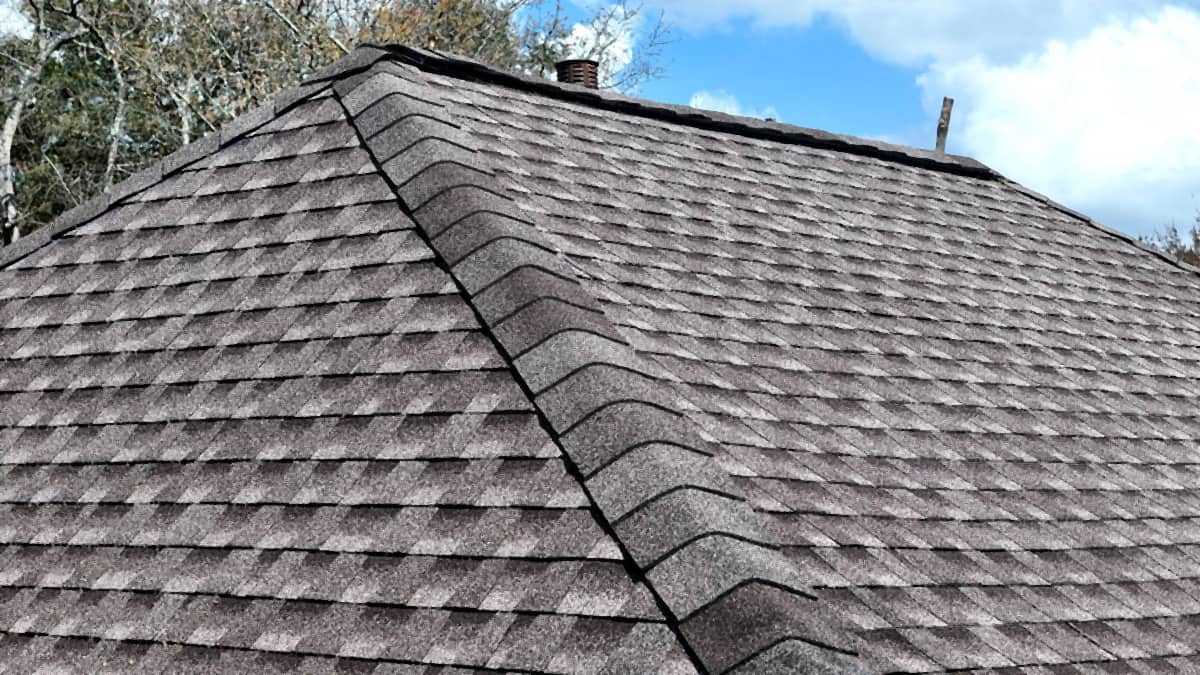
Asphalt — the GAF Timberline HDZ system (our core offering)
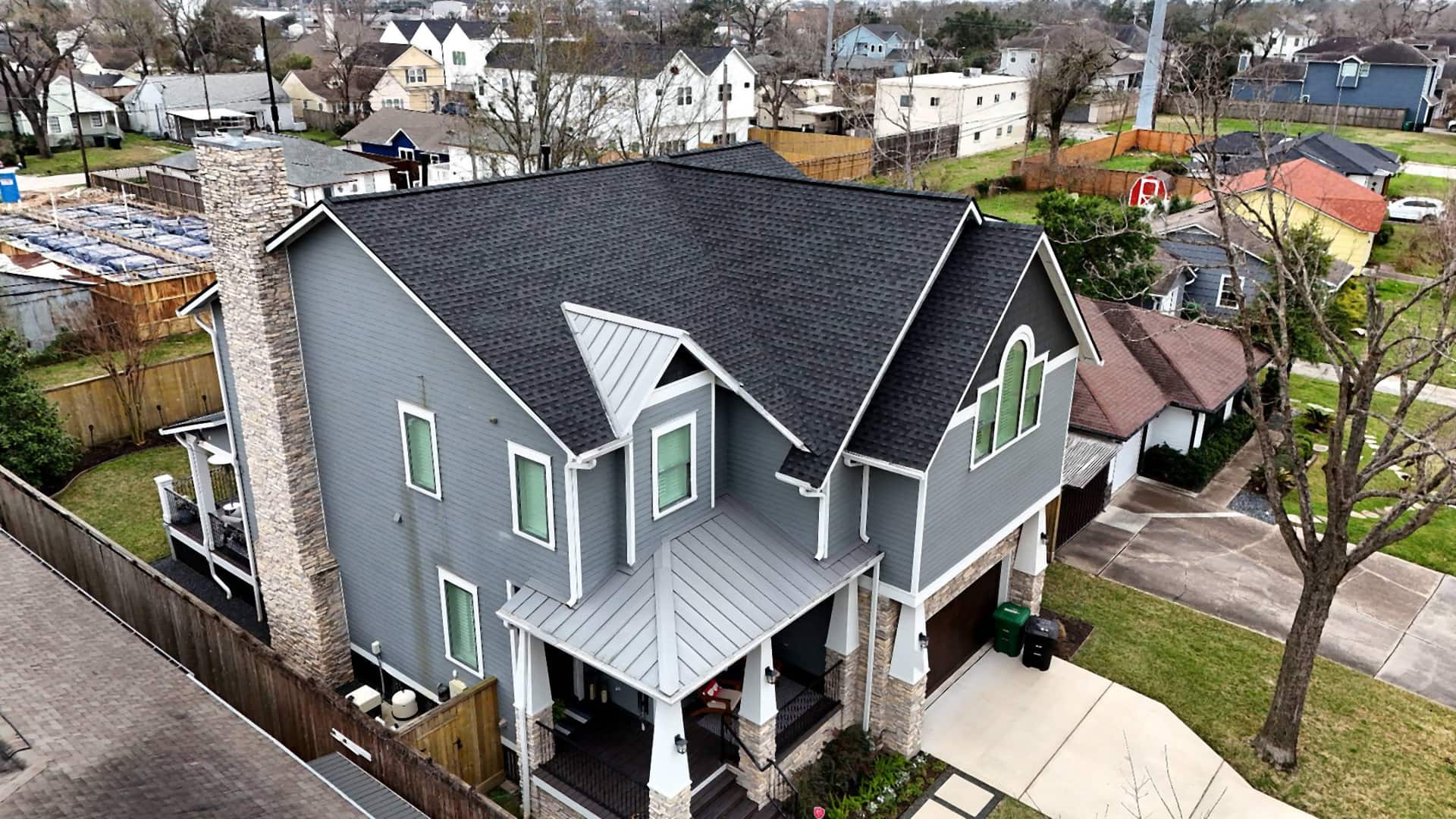
Architectural asphalt is the most common roof in Houston for good reasons, and the GAF Timberline HDZ system is what we install as standard. It's the most accessible price point, proven across millions of roofs, installs cleanly and quickly, and is easy to repair years later because the parts are everywhere.
Wind: Timberline HDZ is engineered for it. Installed properly, it carries a 130 mph wind rating, and when we build the full qualifying GAF system, GAF's WindProven Limited Wind Warranty applies — a manufacturer wind warranty with no maximum wind-speed cap. That coverage depends on the complete GAF system being installed, not the shingle alone.
Algae: StainGuard Plus protection resists the blue-green algae staining that streaks so many Houston roofs.
The honest trade-off: asphalt has the shortest lifespan of the three, and Houston heat shortens it further — the real-world number is usually below the spec on the wrapper. It's the right roof for most homes; it just isn't the longest-lived roof.
Metal — standing seam and corrugated R-panel
Yes, we install metal — and we build it for water protection, not just looks. There are two systems we offer:
- Standing seam — clean, modern, concealed fasteners; the premium metal look.
- Corrugated R-panel — exposed-fastener panels, more economical, a workhorse look that suits a lot of Houston properties.
Either way, we build with thick-gauge metal and run full ice & water shield underlayment across the entire deck — not just the valleys and eaves. That full-deck barrier is the difference between a metal roof that looks good and one that keeps water out under Houston's worst rain.
Lifespan is decades longer than asphalt — commonly 40 to 70 years. Metal also reflects solar heat instead of absorbing it, which in a Houston summer can mean a cooler attic and lower cooling bills. And its wind performance is excellent, particularly standing seam — among the best wind performers we install.
The honest trade-offs: higher upfront cost than asphalt; large hail can dent metal (usually cosmetic, not a leak, but worth knowing); and metal demands a skilled install — done wrong, the fasteners and seams are where it fails. The "metal roofs are loud in the rain" worry is mostly a myth on a properly decked-and-underlaid roof.
Specialty tile — clay, cement, and slate
For the right home, nothing else looks like tile — and nothing lasts longer. It fits Spanish and Mediterranean architecture, higher-end neighborhoods, and homeowners who want a roof that can outlive the mortgage: clay and cement tile suit Houston's Spanish-style homes, and slate is the classic on historic and high-end properties.
Lifespan is the longest of all — tile and slate can last 50 to 100 years or more. Tile also handles Houston heat beautifully — airflow beneath the tiles plus the material's thermal mass both help — and it's highly fire-resistant.
The honest trade-offs come down to three things. First, weight: tile is heavy, so the structure has to carry it, and not every house can take tile without reinforcement. Second, cost: it's the highest of the three. Third — the one most homeowners never hear — the tiles outlast the underlayment beneath them. On a tile roof it's usually the underlayment that fails first and needs replacing, while the tiles themselves are lifted, set aside, and reused. Individual tiles can also crack under heavy impact, but those are spot repairs.
The comparison, side by side
Relative terms only — every roof is specific to your home, and the real numbers depend on the install and the conditions it lives through.
| Asphalt — GAF Timberline HDZ | Metal — standing seam / R-panel | Tile — clay / cement / slate | |
|---|---|---|---|
| Typical lifespan | ~25–30 yrs (less in Houston heat) | ~40–70 yrs | 50–100+ yrs (underlayment replaced sooner) |
| Relative upfront cost | Most accessible | Mid-to-high | Highest |
| Wind | Excellent (130 mph; WindProven-eligible) | Excellent (esp. standing seam) | Good; depends on fastening |
| Hail | Good; can bruise | Good; large hail dents (cosmetic) | Fair; can crack on heavy impact |
| Heat / UV | Good; heat speeds aging | Excellent; reflects heat | Excellent |
| Energy efficiency | Standard | Excellent | Excellent |
| Weight on structure | Light | Light | Heavy — needs capacity |
| Maintenance | Low–moderate | Low | Low; spot tile repairs |
| Aesthetic range | Wide, dimensional | Modern or industrial | Distinctive; Spanish / historic |
| Repairability | Easy | Moderate | Tile reusable; matching varies |
How we actually help you decide
We don't start with the material. We start with five questions:
- Budget — what's realistic right now.
- How long you plan to stay — a roof you'll live under for 30 years justifies a different investment than one on a house you'll sell in five.
- Your structure — especially for tile, whether the house can carry the weight.
- Your neighborhood and home's style — what fits, and what any HOA or historic-district rules require.
- Insurance and exposure — how your roof is likely to take wind and hail, and how that plays into coverage and future claims.
For most Houston homes the answer is a properly built GAF Timberline HDZ system. For homeowners who want maximum lifespan and energy performance and are ready to invest, metal earns its keep. For the right architecture and budget, tile is in a class of its own. All three are honest choices — the wrong choice is a good material installed badly.
What doesn't change, whatever you choose
The surface material gets all the attention, but the roof that lasts is the one built right underneath it — proper underlayment, correct flashing, balanced attic ventilation, and clean workmanship. That's true of every roof we install, and it's backed by our 10-year workmanship warranty. (Specialty trades outside roofing may carry different terms.)
Not sure which roof your house actually needs?
That's the conversation we're best at. Reach out for a straight assessment — including which material we'd put on our own house in your situation.
Call (346) 276-6492 or email Aldo@handyhandsroofing.com for an honest, no-pressure assessment of which roof fits your home.
Questions, answered
Common questions
Is metal or asphalt cheaper for a Houston roof?
Asphalt costs meaningfully less upfront — that's why the GAF Timberline HDZ system is our core offering and the right value answer for most homes. Metal costs more to install but lasts far longer, so the longer you plan to stay in the house, the better its math gets.
Does a metal roof make a Houston house hotter?
The opposite — standing seam metal reflects heat instead of absorbing it, which is one of its real advantages in our climate. Asphalt absorbs more heat, which is part of why attic ventilation matters so much on a shingle roof here.
Which handles hail better, metal or asphalt?
Neither is invincible. Standard shingles can lose granules and seal to hail; that's why we offer the Class 4 impact-resistant Timberline AS II as an upgrade. Metal resists puncture well but can take cosmetic dents that some insurance policies exclude. An honest conversation about your policy is part of the decision.
How do I actually choose?
We install asphalt, metal, and tile, so we have no material to push. The honest inputs are your budget, how long you plan to stay, your roof's geometry, your HOA or deed restrictions, and what fits the neighborhood. We'll walk you through good/better/best options against those, not a sales script.
Free, no-pressure
Get your free roof report
We get on the roof, and you get a real document — not a sales pitch. You get photos of every problem area, written findings in plain English, and a repair estimate if a repair is the honest answer. Emailed to you and left with you in print — yours to keep, whether you hire us or not.
- Photos of every problem area on your roof
- Written findings, in plain English
- A repair estimate, if a repair is the honest answer
If it's storm damage, we handle the insurance claim with you. Financing available.
Roof leaking? We answer 24/7 — call any hour. Or email Aldo@handyhandsroofing.com
Get your free roof report
Name and phone is all we need — we'll call you back. No obligation.
Got it — we have your details
Thanks — we’ll contact you about your request. Prefer to talk now? Call (346) 276-6492.
GAF Certified · 10-Year Workmanship Warranty · Insurance restoration specialists